
How Much Traffic Should My Website Get?
You Deserve More Traffic. But Do You Know How Much Your Website Should Get?
Every owner wants more traffic, but few know what their market can actually deliver. Through keyword and competitive research, we can tell whether you're fishing in an ocean, a lake, or a pond, and what kind of numbers you can expect.

TL;DR
- Every owner wants more traffic. The better question is how much traffic your website should get in your market.
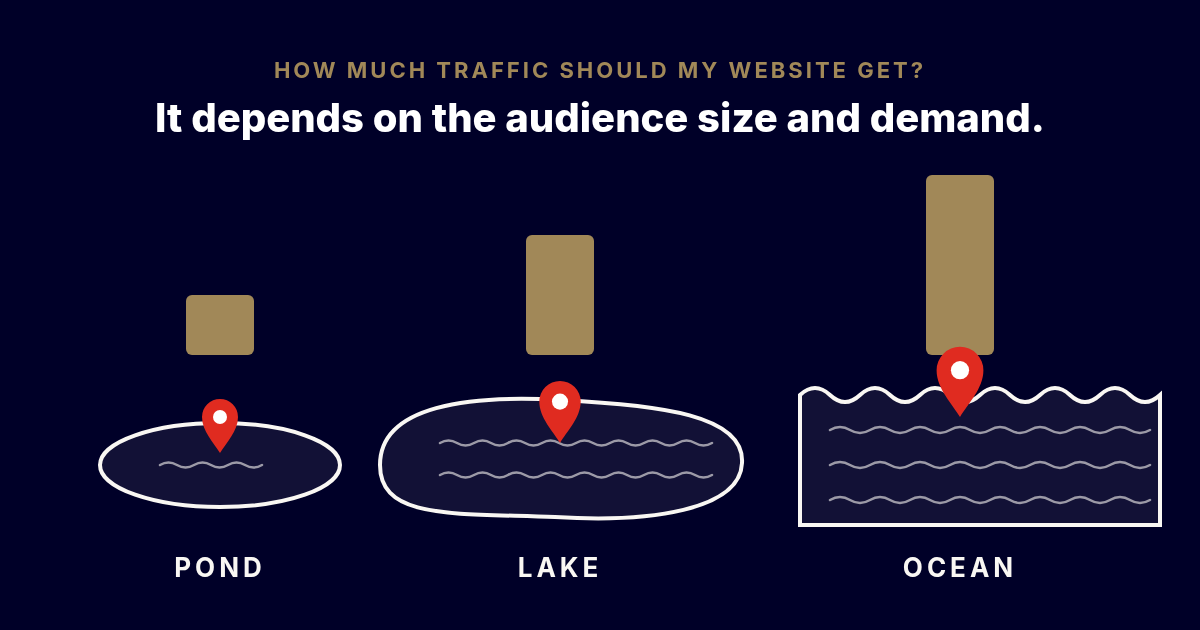
- Tim sizes a market as an ocean, a lake, or a pond. You can't expect ocean-level traffic from pond-level keywords.
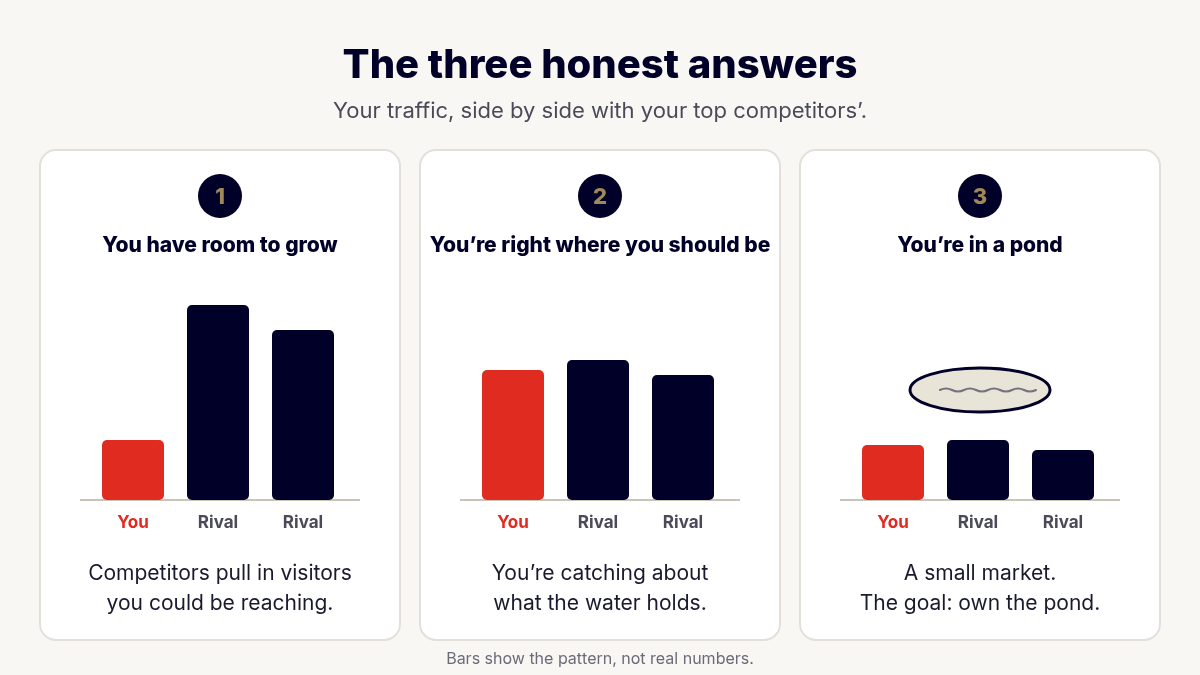
- A side-by-side look at your top competitors' traffic and map rankings gives one of three honest answers: room to grow, right where you should be, or a small market.
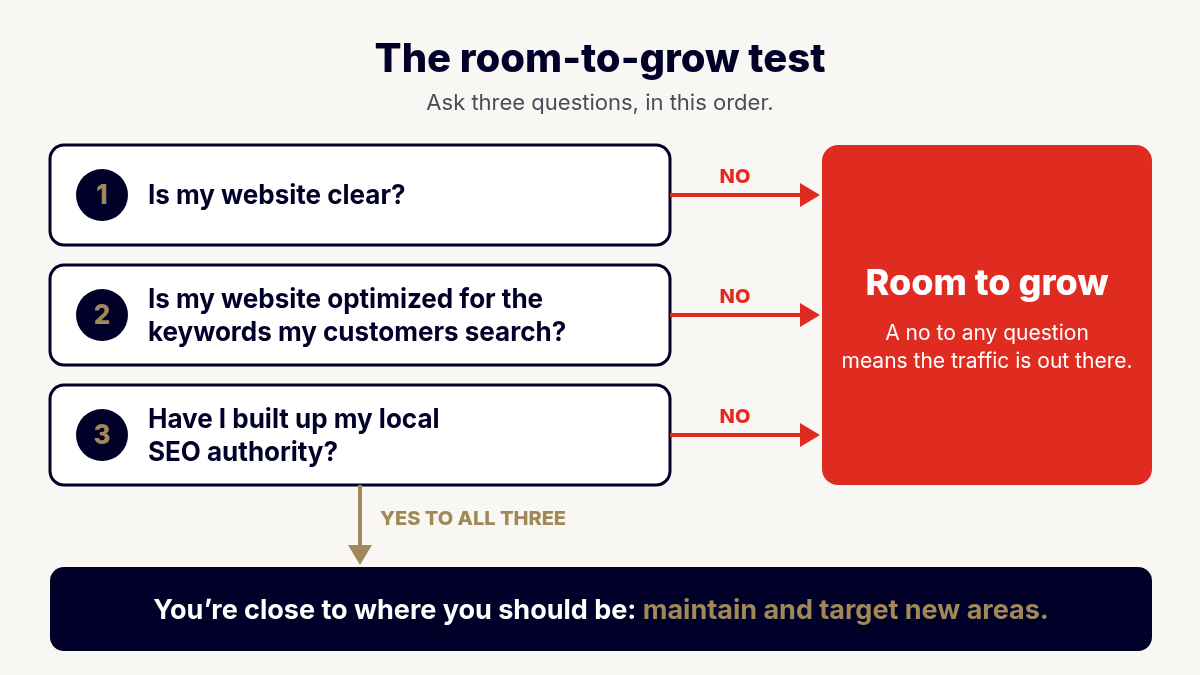
- The room-to-grow test: Is your website clear? Is it optimized for keywords? Have you built local SEO authority? A no to any of them means room to grow. Yes to all three means maintain and target new areas.
- More isn't always better. A Portland client traded thousands of out-of-area blog visitors for less traffic and higher-quality local leads. Once you're where you should be, target new areas one at a time.
On this page
- You deserve more traffic. But how much?
- How much traffic should my website get?
- How I figure out your real number
- The three honest answers
- More traffic isn't always better traffic
- The room-to-grow test
- Already where you should be? Pick your next area
- What more traffic won't do
- Your next step
- FAQs
- About the Author
You work hard. Your crews do good work. Your reviews are strong. So when you look at your website numbers, a thought creeps in: we deserve more traffic than this.
Maybe you do. But here is the honest question I ask every owner who says that: how much traffic should my website get, really? Do you actually know what the right number is for your business, in your market?
Most owners don't, and that isn't their fault. Nobody ever showed them. In this post I'll walk you through how I size a business's market, the three honest answers I end up giving, and a simple test that tells you whether you have room to grow. Then you can stop guessing and start working on the right thing.
Want to know your real number? The Total Online Presence Snapshot compares your website traffic, Google Business Profile, and AI search against your top competitors, and shows the first three fixes to make. It is $297 and includes a 30-minute call with me. Get My Snapshot ($297)
You deserve more traffic. But how much?
Every business owner I work with wants more traffic.
As I put it when we talked this through: "The reality is, business owners have always wanted more traffic... typically business owners always want more."
Wanting more is healthy. You built something good, and you want people to find it. The problem is that "more" is not a goal. "More" is a feeling, and a feeling makes a poor yardstick for marketing decisions.
Here is what happens when "more" is the only target:
- You can't tell whether your current website traffic is good, bad, or normal.
- You can't tell whether the SEO company you hired is doing its job.
- You may spend money chasing visitors who were never going to exist in your market.
- Or you may give up too early on a market that has plenty of room left.
So before we talk about getting more traffic, let's answer a better question: how much traffic should you expect in the first place?
How much traffic should my website get?
To better explain how much traffic you should expect, I use the analogy of an ocean, a lake, or a pond, because it paints a good picture. Then I ask: if we're fishing in one of these, which one is it? The answer tells me the size of the audience we're trying to attract.
The size of the body of water is the number of people searching for what you sell. Your keywords (the words and phrases people type into Google) set how big that water is.
- An ocean is a big market. Lots of people search for this every month, in lots of places.
- A lake is a solid, mid-size market. Steady demand, but with clear edges.
- A pond is a small market. A handful of searches a month, often for a niche product or a very specific service.
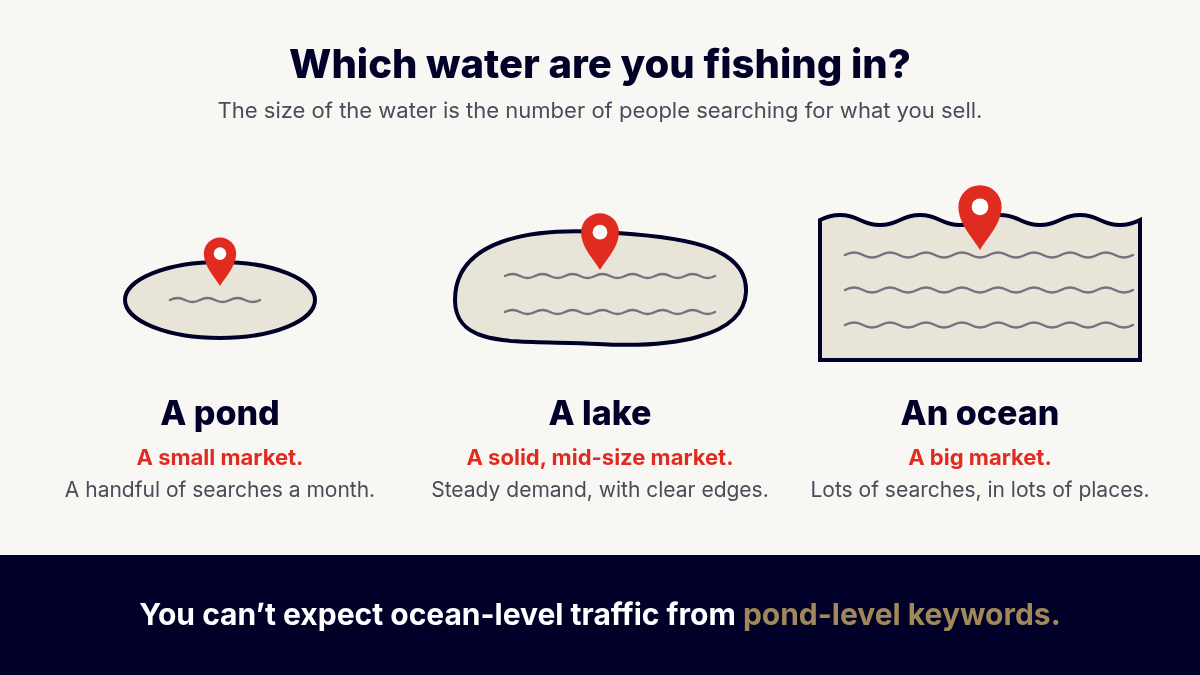
The size of the water sets how much traffic you can expect. In my words: "If you are targeting keywords that are pond type keywords, you can not expect to get ocean level of traffic."
The reverse is also true. If your business belongs in an ocean and you're only pulling in lake or pond traffic, "you've got a lot of room to grow."
That's why the same monthly traffic number can be a great result for one business and a sign of trouble for another. Your traffic number only means something next to the size of your market.
How I figure out your real number
I don't guess at the size of the water. I look at what's actually happening in your market, side by side with the businesses you compete against. Here is the order I work in.
Step 1: See how much traffic you actually get
First, I use SEO research tools such as SpyFu or Semrush to see how much traffic your website gets and how many keywords it shows up for.
Often the answer is very few keywords and very little traffic. When I see that pattern, the cause is usually one thing: the website hasn't been optimized. Optimizing means writing and setting up each page so Google can understand what you do, where you do it, and who it's for.
Step 2: Put your numbers next to your competitors'
This is where the ocean, lake, or pond becomes clear. I search for what your ideal customers would type, see which businesses show up at the top, and compare their traffic with yours.
Sometimes owners expect huge numbers, and then we find that even the top-ranking businesses in their market are in the same ballpark as they are. Other times the leaders are pulling far more traffic, which tells us there's real room to grow.
Either way, the owner finally has a real comparison instead of a feeling.
Step 3: Check where you show up on the map
For a local service business, your Google Business Profile (the listing that shows up in Google Maps and the map results) matters as much as your website. I read your website to figure out the best keyword for what you offer, search for that keyword, and see where your profile ranks.
Position matters more than most owners realize. Here's what I've seen: most searchers click the first profile, because they believe it's the best. That share of clicks "drops in half for the second, and then it drops in half again for the third." If you're fourth, fifth, sixth, or on the second page, you're basically invisible.
So part of "how much traffic should I get?" is really "where do I rank on the map?" Google says local results are based mainly on relevance, distance, and prominence (Google Business Profile Help). You can't change the distance between you and a searcher. You can work on the other two.
The three honest answers
After that research, I give the owner one of three answers. I try to give the honest one, even when it isn't the one they hoped to hear.
As I described it: "Sometimes I look at the results and see that there is a lot of room to grow. Sometimes I see that they're right at where they should be, and then sometimes it's a really niche product, so it's going to be a pond, a small market."
Answer 1: You have room to grow
In my experience, this answer comes up often, and it's good news. Your market is bigger than the traffic you're getting. Your competitors are pulling in visitors you could be reaching.
When this is the answer, the path forward is usually clear. We optimize the website for the right keywords and build up your local authority, so Google trusts you enough to show you. (The test in the next section shows you how to spot this.)
Answer 2: You're right where you should be
Sometimes the research shows that your traffic is in line with your market and your top competitors. You're fishing the right water, and you're catching about what the water holds.
That can be hard to hear when you were hoping for a big jump. But that answer is also a relief. Being on target means your past marketing work wasn't wasted, and you can stop wondering whether something is broken.
When you're right where you should be, the job changes. You maintain what's working and look for new ground, such as new service areas. I'll cover that further down.
But what if your numbers are right and you're still losing clicks to your competitors? Then I recommend Competitive Blogging. In a quarterly meeting, we compare the content on your top competitors' websites to the content on yours.
From there, we start creating very targeted content, so you show up when your ideal clients start searching, and they come to your website instead of your competitors'.
Answer 3: You're in a pond
Some businesses sell a niche product or a very specialized service. Not many people search for it, because not many people need it. That's a pond: a small market.
A pond isn't bad news. A small market can still be a very profitable one. But you have to set your expectations to match. You won't get ocean-level traffic from pond-level keywords, no matter how much you spend.
In a pond, the goal is to own the pond. Show up for nearly every search that exists, make sure every visitor understands what you do, and turn more of those visitors into calls.
More traffic isn't always better traffic
There's a flip side to the question "how much traffic should I expect?" Sometimes an owner already has plenty of traffic. It's just the wrong traffic.
When Jens and Marlys Wiegand of Adrette, a custom window treatment company in Portland, Oregon, first called me, they were getting "literally thousands of people coming to their website from their blog." They write great blog posts, and those posts were getting a lot of traction and attention on custom window treatments, custom drapes, and curtains.
But when I pulled up the analytics, the visitors were coming from "New York and the East Coast and literally all over the world." Adrette serves the Portland market, and they weren't getting the local customers they needed there. When I did my research, I also found that they hadn't really established a local presence.
So we did the local SEO authority work and took some of the focus off the blog and off national-exposure blog pieces. Now they're getting less traffic. But they're getting higher-quality leads, and those leads are coming from the target areas they want to reach.
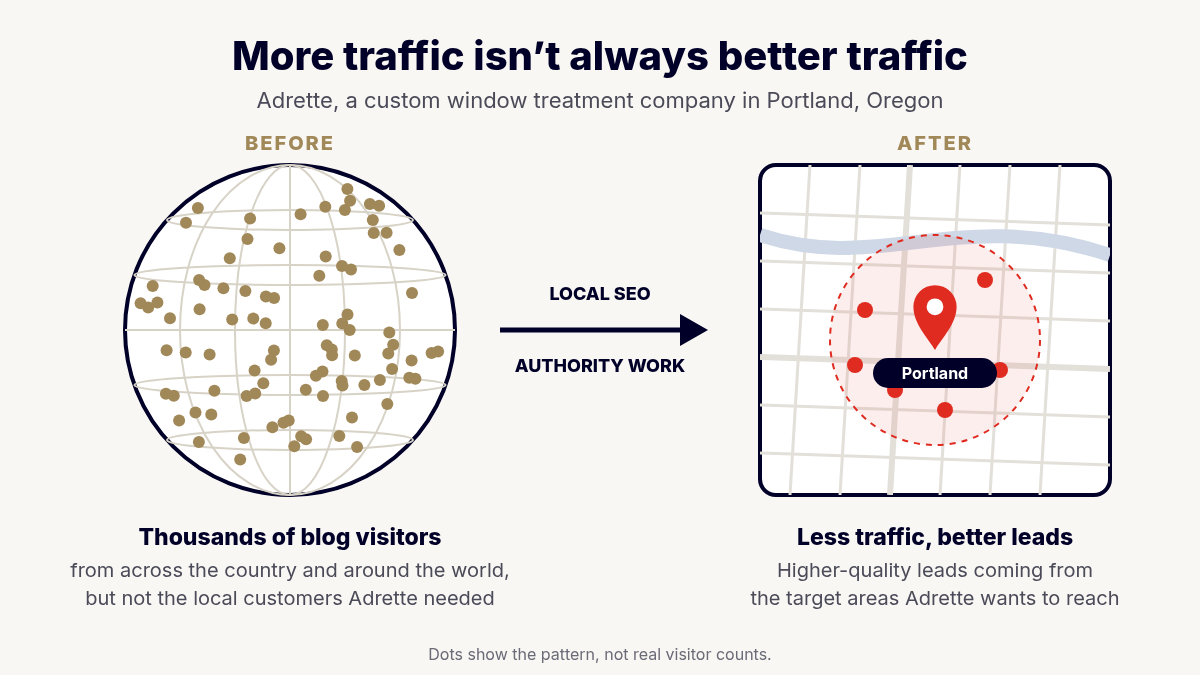
As I put it: "More isn't always better, if the more is not your ideal client or a client that you can actually serve because they're on the other side of the country."
So when you ask how much traffic you should expect, ask a second question too: traffic from whom, and from where? For a local business, the right number counts the people you can actually serve.
The room-to-grow test
If you want a quick way to tell whether you have room to grow, ask yourself three questions, in this order:
- Is my website clear?
- Has my website been optimized for the keywords my customers actually search?
- Have I built up my local SEO authority, meaning my Google Business Profile, citations, reviews, and steady profile activity?
Here's how I put the last two: "If they haven't optimized their website for keywords and gone through the local SEO authority builder, then there's definitely room to grow. If they have, then it's OK."
So the test is simple:
- If you answered no to any of the three, you almost certainly have room to grow. The traffic is out there, and your website or profile isn't set up to catch that traffic yet.
- If you answered yes to all three, you're likely close to where you should be. The next step is to maintain what you've built and start targeting specific locations.
What each question means in plain terms
A clear website comes first, before any numbers. Is your website clear? Does it make sense? Would anything on the page, like the menu, confuse a first-time visitor? Clarity comes first because traffic numbers can fool you. A website can attract visitors and still lose them in the first few seconds. (The Advantage Roofing story below shows how.)
Keyword optimization builds on that clarity. Local SEO rewards clarity. Before I touch keywords, I walk through the StoryBrand framework (created by Donald Miller) so I understand exactly who the business wants to reach, what that customer wants, and what's in the way. Then I research the words and questions those customers actually type. I explain how those two pieces fit together in StoryBrand SEO.
Local SEO authority is the work that gets Google to trust your business enough to show it on the map. At StoryWorks, that's our 90-day Authority Foundation: Google Business Profile optimization, 50+ citations built and verified, a review process, and profile updates three times a week. You can see the full breakdown on the Local SEO services page. If you're not ready for 90 days, the Map Pack Jumpstart gets your profile right in 14 days and shows you where you rank, block by block.
If your profile isn't even verified yet, start there first. Here's how to get your Google Business Profile verified.
Before you chase more traffic, check the traffic you already have
There's one more trap worth naming. Sometimes the traffic isn't the problem at all.
When Advantage Roofing first called me, the owner was frustrated. He had invested thousands in SEO and didn't think it was working. When I did the research, I found the SEO was working. People were coming to the website. But the homepage was sending them away.
Once we corrected the homepage by adding clarity and StoryBrand messaging, they started picking up new leads almost immediately. When they first called, they were averaging around 12 to 19 leads a month. This past August they had 82. I'd estimate about 95% of their leads now come from local SEO work. The company already had a strong reputation; our job was helping more of the right people find it and act on it. You can read the Advantage Roofing case study for the full story.
The lesson: more traffic only helps if your website turns visitors into calls. Check both.
Already where you should be? Pick your next area
If you've passed the room-to-grow test, more traffic doesn't come from doing the same things harder. New traffic comes from going after new ground on purpose.
For clients in ongoing local SEO, we hold a quarterly meeting. As I explained, "I specifically ask the client what products or services they're wanting to promote, and what specific areas are they wanting to target." You know your business and where you want to work. My job is to help you get found there.
Once we pick an area, here's the short version of what I do:
- Research the area. I look at neighborhoods, common landmarks people would know, and zip codes. Google reads copy, so I want those words in your Google Business Profile post updates to help Google pinpoint that you work there.
- Post from the job site. If your crew is working in that area, I want them snapping photos and posting updates from the location. That ties the location to your Google Business Profile.
- See who already ranks there. I search the area to see which company shows up well, then research what's working for them: the keywords they target and the content they create for that area. Sometimes they rank simply because their office is there. Other times, specific content can help you reach the area better.
- Build a location page for key areas. If an area really matters, a dedicated location page is best. The page has a Google map of the area and content about projects you've done there, and every word on the page is about that one location. Not a copy of another city page with the name swapped.
One example: Susan Gailani, Gailani Designs
Susan Gailani's business, Gailani Designs, is based in Naperville, Illinois. When she first contacted me, if I remember right, she ranked around fifth or sixth in Naperville. That's the zone where, as I mentioned above, you're close to invisible.
So we focused on Naperville first. Then we started going after the surrounding areas, until her location map (the grid we use to track where she shows up on Google Maps) started going green. From there, the goal was to reach farther north into the Chicagoland area. We picked specific areas and went after them, and one by one, her growth grew with them.
There was no shortcut. We repeated the same steps above, area by area.
What more traffic won't do
I want to be straight about the limits here.
- There's no guaranteed number. I can show you what your market looks like and how you compare. I can't promise a specific amount of traffic or a specific number of calls. Every market is different.
- Traffic isn't leads. If your website confuses people, more visitors just means more people leaving. And visitors from places you don't serve won't become customers. Fix the message and aim at the right area first.
- A pond stays a pond. No amount of work turns a small market into a big one. In a pond, the win is owning it.
- Not every business needs every step. If you're already right where you should be, you may only need to maintain what you have and add one new area at a time. If you have room to grow, start with your website and Google Business Profile before anything else.
Your next step
You deserve to know where you stand. Not a feeling that you should have more traffic, but a real comparison: how big your market is, how you stack up against your top competitors, and whether you have room to grow, are right on target, or are fishing in a pond.
Once you know that, the next step gets a lot clearer. You'll know whether to fix the website, build local authority, or go after a new area. And you can stop spending money on a guess.
Find out how much traffic your website should get. The Total Online Presence Snapshot is $297. You get a 6-page report on your website, Google profile, and AI search, side by side with your competitors, three prioritized fixes, and a 30-minute call with me. Get My Snapshot ($297)
New to the idea of a "total online presence"? Read What Is a Total Online Presence? Ready to go after your top competitors with content? See Competitive Blogging.
FAQs
How much traffic should my website get?
There's no single right number; how much traffic your website should get depends on the size of your market and what your top competitors get. I compare your traffic and keywords side by side with the businesses that rank above you, then tell you whether you have room to grow, are about where you should be, or are in a small market.
How do I know if my website traffic is good?
Compare your traffic with your competitors, not with a general average. If the top businesses in your market get far more traffic than you do, you have room to grow. If they're in the same ballpark, your traffic is probably about right for your market.
Why isn't my website getting more traffic?
The most common reason I see is that the website hasn't been optimized for the keywords customers actually search. The second is weak local authority, meaning the Google Business Profile, citations, reviews, and profile activity haven't been built up yet. A third possibility is that you're in a small market, where there simply aren't many searches.
What does ocean, lake, or pond mean for website traffic?
The ocean, lake, and pond describe the size of your market, based on how many people search for what you sell. An ocean is a big market, a lake is mid-size, and a pond is small. You can't expect ocean-level traffic from pond-level keywords.
Is more website traffic always better?
No. For a local business, more traffic only helps if those visitors are people you can actually serve. One of my clients, a custom window treatment company in Portland, Oregon, had thousands of blog visitors from across the country and around the world but not the local customers it needed; after we built its local presence, it got less traffic but higher-quality leads from its target areas.
Does ranking position on Google Maps affect my traffic?
Yes, a lot. In my experience, most searchers click the first Google Business Profile, about half as many click the second, and about half again click the third. Below the top three, a business is close to invisible.
Where should I start if I don't know how much traffic I should be getting?
Start with a side-by-side comparison against your top competitors. The Total Online Presence Snapshot from StoryWorks Marketing reviews your website, Google Business Profile, and AI search for $297, so you know where you stand and what to fix first.
About the Author
Tim Yates is the founder of StoryWorks Marketing in Waukee, Iowa, in the Des Moines area. He has been a Certified StoryBrand Guide since 2020, and he is a StoryBrand Certified Coach and a Duct Tape Marketing Certified Fractional CMO. He has served as a StoryBrand Guide and Coach on 20+ StoryBrand livestreams alongside Donald Miller, J.J. Peterson and April Sunshine Hawkins, and he has coached 102 businesses through the StoryBrand framework since 2020. He helps owner-led businesses clarify their message and get found on Google, on the map, and in AI search.
Search and AI tools keep changing. When something on this page stops being true, I will update it.
Verification: StoryBrand directory · Duct Tape Marketing consultant profile
Related reading: StoryBrand SEO · What Is a Total Online Presence? · How to Get Your Google Business Profile Verified · Does StoryBrand Hurt SEO?