
The short version (TL;DR)
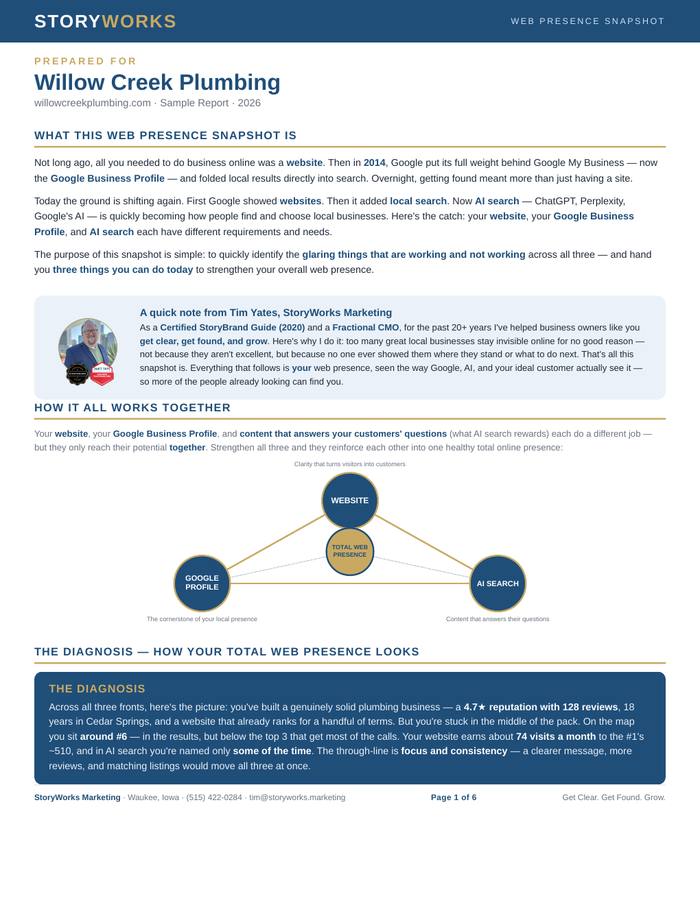
Getting found online is no longer about any single thing. A total online presence has three parts — your website, your Google Business Profile, and your visibility in AI search (ChatGPT, Perplexity, Google’s AI) — and they only work when they tell the same story. Most local businesses aren’t failing from lack of effort; their pieces just aren’t connected. Align all three and they compound: a clearer site feeds Google, consistent reviews and listings win the local map, and together they get AI to recommend you.
- Website: a visitor should “get it” in about 3 seconds — clarity beats cleverness.
- Google & the local “stack”: the top 3 map results are won with your profile, reviews, and consistent info — not your website.
- AI search: AI names the businesses whose site, profile, and reviews all agree — plus content that answers real questions.
What’s inside
- What a total online presence actually means
- Pillar 1 — Your website: clarity before cleverness
- Pillar 2 — Your Google Business Profile & the local stack
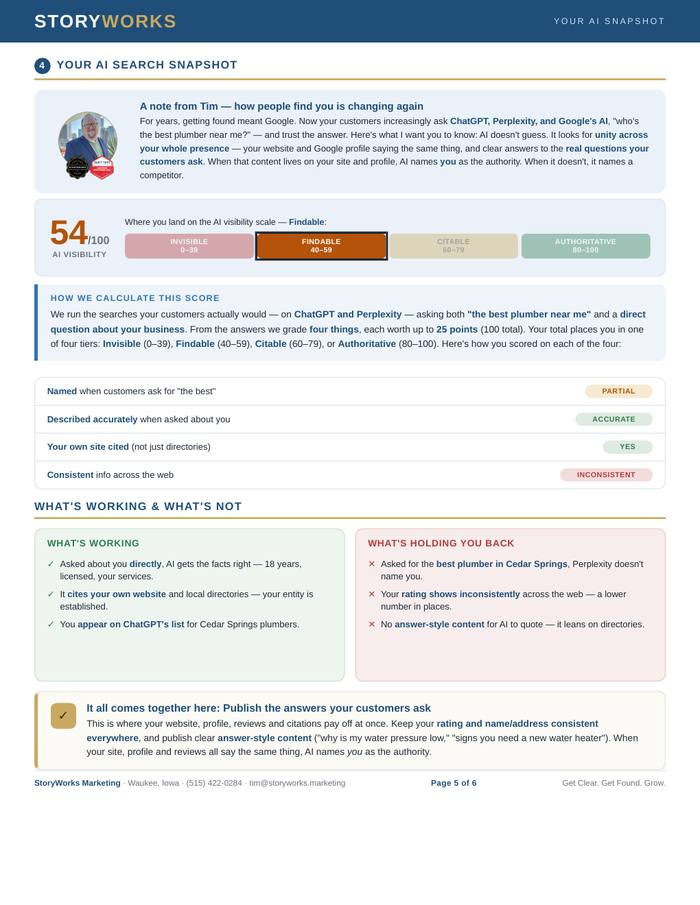
- Pillar 3 — AI search: the new front door
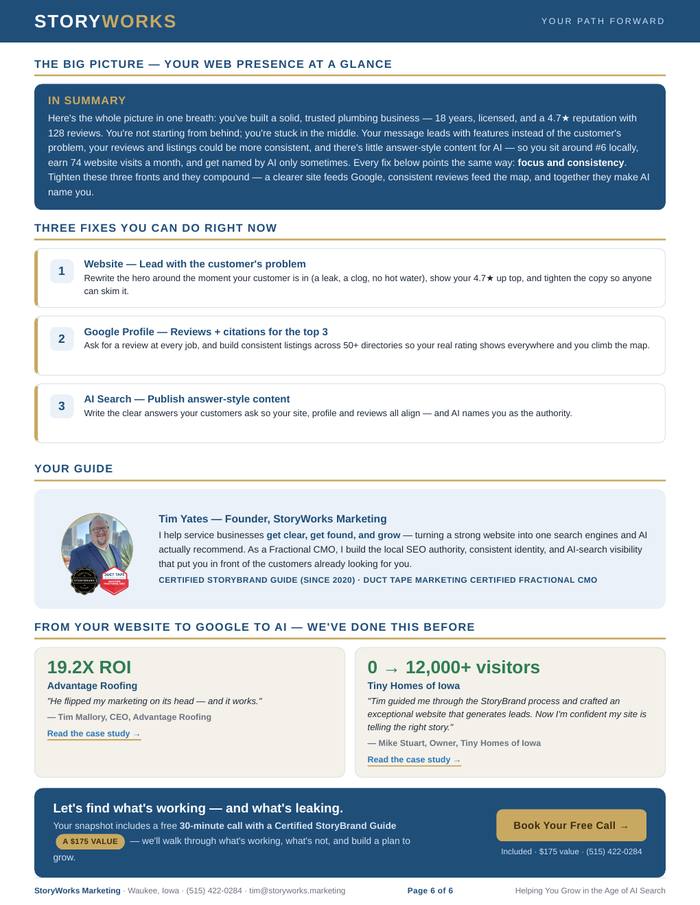
- The real secret: the three pieces talk to each other
- The mistake I see most often
- How to find out where you stand
- Frequently asked questions
You've done the things.
You paid for the website. You post on Facebook and Instagram when you can catch a breath. Maybe you boosted a post, claimed your Google listing, or handed a marketing company a check every month. You've read the articles. You've tried the tips. And still — the phone doesn't ring the way it should. New customers trickle in from word of mouth, not from all the work you've put into being found online.
If that's you, I want to say something clearly: you're not lazy, and you're not doing too little. Most owners I meet are doing more than enough. The problem usually isn't effort. It's that the pieces aren't connected — so all that work leaks out the sides instead of adding up.
I've personally reviewed the online presence of 100+ local businesses, and the same quiet frustration shows up again and again. A great company, a real reputation, an owner pouring in the hours — and an online footprint that somehow makes them look smaller than they are. It's genuinely aggravating, because the effort is there. The results just aren't.
Here's the good news. Once you understand what a total online presence actually is, the fog lifts. You stop guessing, stop throwing money at random tactics, and start building something that compounds. Let's walk through it.
What a "total online presence" actually means
Not long ago, being found online meant one thing: having a website. Then, back around 2014, Google put its full weight behind local search and the Google Business Profile (what used to be called Google My Business). Suddenly a website wasn't enough — you also had to show up on the map.
Today the ground is shifting again. Your customers are increasingly asking AI tools like ChatGPT and Perplexity questions like "who's the best roofer near me?" or "what's a good bakery in town?" — and acting on whatever answer they get. That's a brand-new front door to your business, and most owners have no idea what those tools are saying about them.
So a total online presence isn't your website. And it isn't your Google listing. And it isn't your AI reputation. It's all three — working as one system.
Think of it as a triangle. Your website, your Google Business Profile, and AI search each sit at a corner. Each does a completely different job. But they only reach their potential when they point at each other — when the story they tell is the same story, told consistently, everywhere a customer might look. Strengthen all three and they stop competing for your attention and start reinforcing each other.
Here's how the three pieces compare at a glance:
| The piece | Its job | What “healthy” looks like | The #1 mistake |
|---|---|---|---|
1Your website |
Turn visitors into customers with instant clarity | A visitor knows who you are, what you do, and what to do next — in about 3 seconds | Clever, vague, or “about us” messaging that makes people think too hard |
2Your Google Business Profile |
Get you into local search and the map “stack” | A complete, active profile with a steady flow of real reviews and consistent business info everywhere | Claiming it once, then letting it sit — thin reviews, mismatched name/address/phone |
3AI search |
Get you named and recommended by ChatGPT, Perplexity & Google’s AI | Your site, profile, and reviews all say the same thing, plus content that answers real customer questions | Assuming AI “just knows” you — with nothing consistent for it to pull from |
Now let's take each corner one at a time.
Pillar 1: Your website — clarity before cleverness
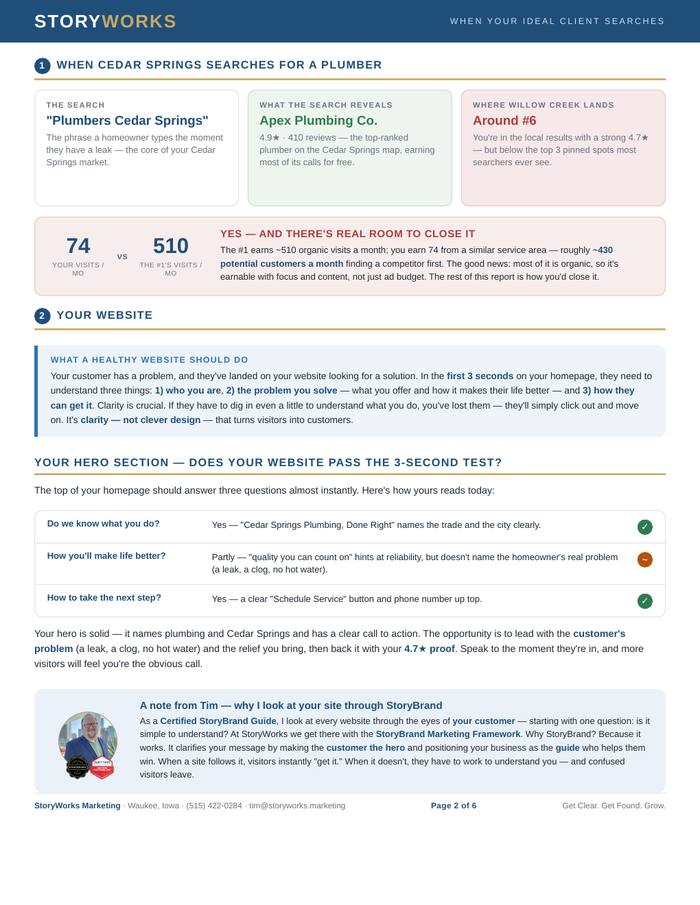
Your website has exactly one job: turn a visitor into a customer. Not win a design award. Not impress your competitors. Convert.
And it has to do that job fast. When someone lands on your homepage, they're silently asking three questions, and you have about three seconds to answer them:
- What do you do?
- How will you make my life better?
- How do I get it?
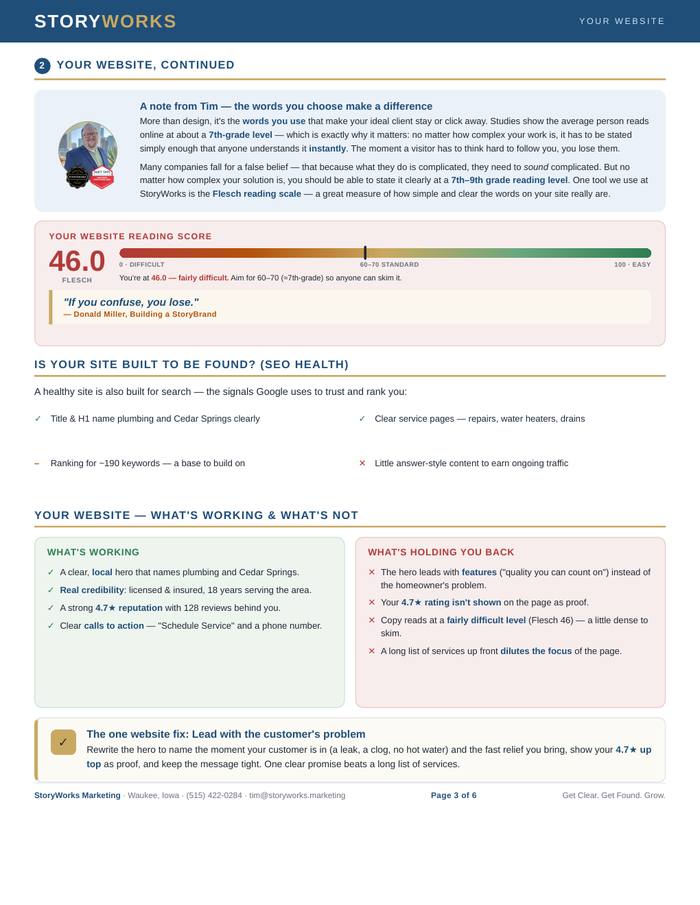
If a visitor has to dig — even a little — to figure out what you offer or how you help, most of them won't. They'll click back and choose someone clearer. This is the single most common website problem I see: businesses lead with a clever slogan or an inward "we're the best" message instead of plainly naming the customer's problem and the outcome they deliver.
The fix isn't a prettier site. It's a clearer one. A useful rule of thumb: the words on your page should read at about a 7th-to-8th-grade level. That's not dumbing it down — it's respecting a busy person skimming on their phone. This is the whole idea behind the StoryBrand framework: make the customer the hero of the story and position your business as the guide who helps them win. As Donald Miller puts it in Building a StoryBrand: "If you confuse, you lose." (It's exactly the lens we use when we build a StoryBrand website.)
Pillar 2: Your Google Business Profile and the local stack
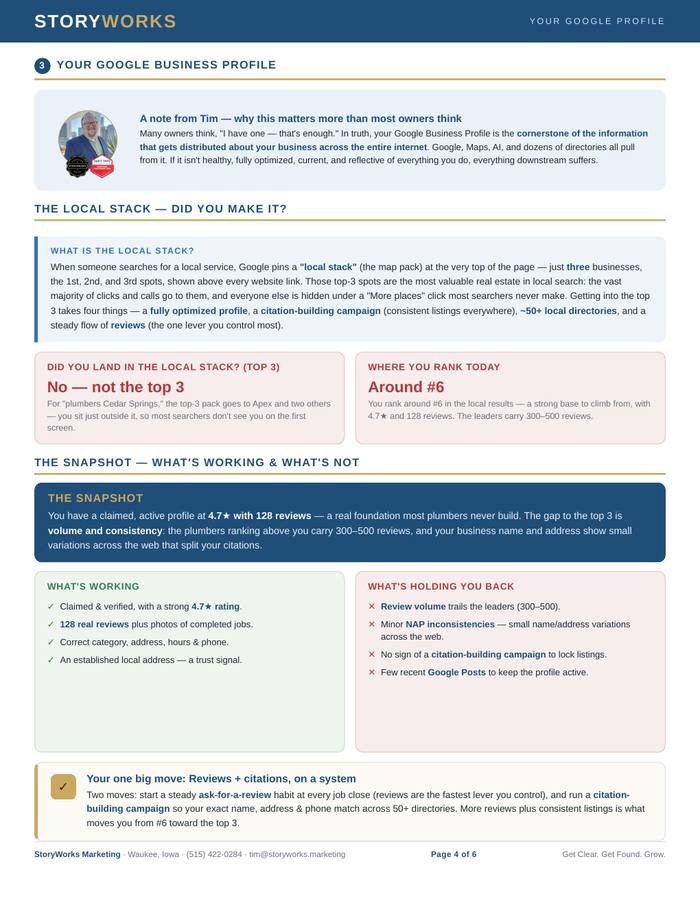
When someone searches "roofer near me" or "best dentist in [your town]," Google shows a special result at the very top of the page: a little map with a short list of businesses pinned to it. People in the industry call it the map pack or the local stack — and it's just three businesses. First, second, and third. Everyone else is hidden under a "More places" click that most searchers never make.
Those three spots are the most valuable real estate in local search. And here's the part that surprises owners: you don't win them with your website. You win them with your Google Business Profile and the signals around it. This is the heart of local SEO, and it comes down to a few things:
- A fully optimized profile — correct category, hours, photos, services, and service area. (If yours isn't claimed yet, start by verifying your Google Business Profile.)
- A steady flow of reviews. Reviews are the fastest lever you actually control, and consumer research consistently shows that most people read reviews before choosing a local business.
- Citation consistency. Your exact business name, address, and phone number need to match across the web. When they don't match, Google gets confused and quietly trusts you less.
- Directory presence across the 50-plus places customers and search engines look.
Most businesses claim their profile once and move on. The ones climbing into that top-three stack treat it like a living thing — feeding it reviews and keeping their information consistent everywhere.
Pillar 3: AI search — the new front door
This is the newest corner of the triangle, and it's moving fast. More and more people are skipping the traditional search results entirely and just asking an AI assistant to recommend someone. "Who's the best [what you do] in [your city]?" And whatever ChatGPT, Perplexity, or Google's AI says back — that's the shortlist your customer now trusts.
So how does AI decide who to name? It looks for agreement. It scans your website, your Google profile, your reviews, the directories you're listed in, and anything that's been written about you — and it looks for a consistent, well-established story. When your site says one thing, your profile says another, and there's no clear content answering the questions customers ask, AI has nothing solid to grab onto. So it names a competitor instead.
Getting found in AI search isn't a separate trick. It's the payoff of doing the first two pillars well — plus one addition: publishing clear, helpful, people-first content that answers the real questions your customers ask ("how much does a new roof cost?", "signs you need a new furnace"). When your website, your profile, your reviews, and your content all tell the same story, AI stops guessing and starts recommending you as the authority. (Curious where you stand right now? Our AI Search Readiness Report shows you.)
The real secret isn't the three pieces — it's that they talk to each other
Here's the shift I most want you to take away.
Your website, your Google profile, and your AI presence are not three separate projects to knock out one at a time. They're three parts of one system, and their real power is in how they feed each other:
- A clear website gives Google and AI a confident, consistent story to trust — which helps you rank.
- A strong Google profile with consistent info and real reviews feeds both the local map and the AI tools pulling from it.
- Answer-style content on your site earns search traffic and gives AI something to quote.
Pull one thread and the others move. That's why scattered effort feels so frustrating — a boosted post here, a review there, a new homepage banner — none of it compounds, because the pieces aren't pointing the same direction. But align them, and something better than addition happens: they multiply. A clearer site makes your reviews land harder. Consistent reviews make your AI answers stronger. It all reinforces itself.
That's a total online presence. Not more tactics — more alignment.
The mistake I see most often
After reviewing 100+ local businesses, if I had to name the single most common pattern, it's this: excellent businesses that are nearly invisible online — for no good reason.
Not because they aren't good at what they do. The opposite, usually. It's because their message is split across a dozen directions, their reviews and listings don't match, and there's nothing consistent for Google or AI to hold onto. The reputation is real. The online version of it just hasn't been built to match.
And that's actually encouraging — because it means the hardest part (doing great work and earning trust) is already done. What's left is connecting the pieces so the rest of the world can finally see what your customers already know.
How to find out exactly where you stand
Reading about the three pillars is one thing. Seeing precisely how your business shows up across all three is another — and it's hard to fix what you can't see.
That's exactly why I created the Total Online Presence Snapshot: a clear, honest look at how your business shows up on your website, on Google and in the local map, and now in AI search — with the specific things that are working, the things holding you back, and the highest-impact fixes to make first. It's the same review I've run for 100+ local businesses, packaged so you can act on it.
See your total online presence the way Google, AI & your customers do.
Get a complete, plain-English review of all three pillars for $297 — or book a free 30-minute call and we'll talk through where to start.
Frequently asked questions
What is a total online presence?
A total online presence is the combination of your website, your Google Business Profile (local search), and your visibility in AI tools like ChatGPT and Perplexity — all working together and telling the same, consistent story. Any one piece on its own isn't enough anymore; the results come from how the three reinforce each other.
Why isn't my website enough on its own?
A website only helps people who already found you. It doesn't put you on the Google map for local searches, and it doesn't automatically make AI tools recommend you. To get found by new customers, your website needs to work alongside a strong Google profile and a consistent presence across the web.
What is the local stack (or map pack)?
It's the short list of three businesses Google pins to the top of the page — with a map — for local searches like "plumber near me." Those top three spots capture the majority of clicks and calls. You earn them mainly through an optimized Google Business Profile and local SEO, a steady flow of reviews, and consistent business information everywhere online.
How do I get my business to show up in AI search like ChatGPT?
AI tools recommend businesses that have a clear, consistent, well-established story across the web. Make sure your website, Google profile, and reviews all say the same thing, keep your name, address, and phone identical everywhere, and publish content that answers the real questions your customers ask. The more your information agrees across sources, the more likely AI is to name you.
How often should I work on my online presence?
Treat it as ongoing, not one-and-done. The businesses that win keep a steady rhythm — regularly asking for reviews, keeping their profile and information current, and adding helpful content over time. Small, consistent effort beats a once-a-year overhaul.

About the author
Tim Yates is the founder of StoryWorks Marketing in Waukee, Iowa. A Certified StoryBrand Guide (2020) and a Duct Tape Marketing Certified Fractional CMO, Tim has spent 20+ years helping business owners get clear, get found, and grow. He has personally reviewed the online presence of 100+ local businesses, and built the Total Online Presence Snapshot to give owners an honest, actionable picture of how they show up across their website, Google, and AI search.
Certified StoryBrand Guide (2020) · Duct Tape Marketing Certified Fractional CMO · Direct: (515) 422-0284 · Office: (515) 305-3096 · storyworks.marketing
Sources & further reading
- Donald Miller, Building a StoryBrand — the "make the customer the hero" clarity framework.
- BrightLocal, Local Consumer Review Survey — how consumers use reviews to choose local businesses.
- Google Search Central, Creating Helpful, Reliable, People-First Content — Google's guidance on the content that earns trust (E-E-A-T).
- Google, Google Business Profile — the official home of your local listing.