AI Readiness Signals
The 8 AI Readiness Signals, Applied to a StoryBrand Website
StoryBrand clarity is the start. The eight AI readiness signals show what else AI needs before it will quote and recommend you.

TL;DR
- You can have a clear StoryBrand website and still never get named when someone asks ChatGPT who to hire.
- StoryBrand clarity is the start. The eight AI readiness signals show what else AI needs before it will quote and recommend you.
- StoryWorks scores a site across those signals on a 100-point baseline. Most sites I review land Invisible or Findable.
- The free AI Readiness Snapshot is step one: score, tier, biggest gaps. The paid AI Search Readiness Review builds the archive, re-scores the gaps, runs the interview, and leaves you with a 30/60/90 map -- then a later final score.
- One anonymized StoryBrand Guide (fractional CMO for smaller independent nonprofits) did the first two items on her 30-day list -- homepage FAQ with schema, plus a pillar page for her named method -- and within about four days an ideal client found her on ChatGPT. One experience, not a promise.
On this page
- Your site is clear. AI still skips you.
- Why clarity is not the same as a citation
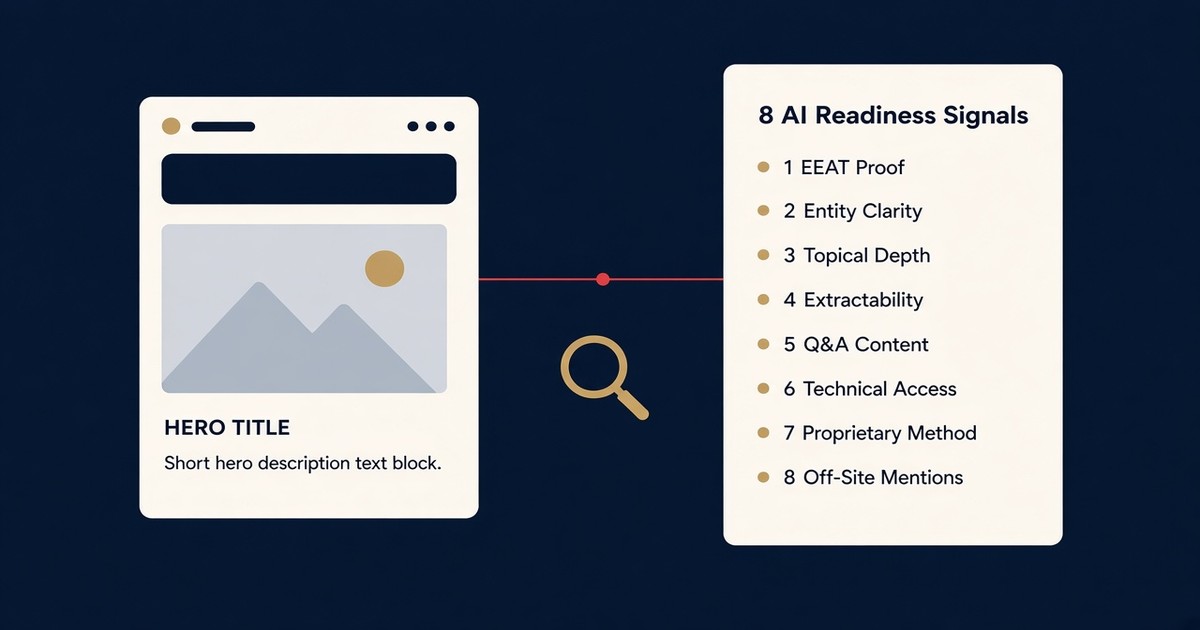
- The eight AI readiness signals, in plain words
- Free Snapshot vs the paid Review
- What this looked like on a real StoryBrand site
- A small note on topical depth
- What to do next
- FAQs
- About the author
You clarified your message.
You cut the fluff. Your homepage finally says who you help, what you offer, how life gets better, and what to do next. A busy buyer can get it in a few seconds. That is the StoryBrand win.
Then someone opens ChatGPT, Claude, Perplexity, or Google's AI tools and asks for a business like yours.
Your name does not come up.
Or it does, and the answer is thin, outdated, or wrong.
I have heard that frustration from owners and from other Guides since I started running these reviews. The site feels finished. The BrandScript is solid. The one-liner works at a networking table. And the machine still will not put your name forward.
Here is the clarifying idea I want you to leave with.
StoryBrand clarity is the start. The eight AI readiness signals show what else AI needs before it will quote and recommend you.
I am a Certified StoryBrand Guide (since 2020). I am still protective of the homepage. I still fight cognitive load. I still want fewer, better words at the top of the page. What I have learned on real sites is simpler than the industry makes it sound: clear messaging gets the human halfway. Machines also need proof on the page, plain entity facts, depth beyond the pitch, answers they can lift, real Q&A, a technical door that is open, something only you can say, and corroboration off your own site.
Those are the AI readiness signals. This post is for Guides and owners who already did the BrandScript work -- and still want AI to name them.
Want a baseline before you change anything? Request your free AI Readiness Snapshot: Request your free AI Readiness Snapshot
Your site is clear. AI still skips you.
StoryBrand teaches you to remove the fog. Donald Miller's framework puts the customer as the hero and the business as the guide. That still matters. A confused visitor leaves. A clear visitor stays long enough to dig in.
AI search adds a second reader.
AI tools do not hand someone ten blue links and wait. They often give one or two answers. To name you, they have to resolve who you are, trust what you claim, and lift a clean sentence from a page they can actually read.
A StoryBrand site can fail that test for boring reasons. The proof lives in sales calls, not on the page. Services are clear to a human who already knows your category, but not stated plainly enough for a machine. The homepage is focused (good), and the rest of the site never covers the territory buyers ask about. Answers sit three paragraphs into a story, so nothing is quotable on its own. FAQs are missing, generic, or not the questions people actually ask AI. Schema, crawler access, or an llms.txt file is missing, so the technical door is half closed. You have no named method a model can attribute to you. Reviews and citations elsewhere do not back up what your site says.
None of that means StoryBrand failed. It means clarity got the human halfway, and the machine still needs structure and proof.
If you want the broader "why AI skips you" framing, I walked six common causes here: Why your business does not show up in AI search.
If you are a Guide worried about homepage length versus depth, that balance is the sibling post: Does StoryBrand hurt SEO?
Why clarity is not the same as a citation
Findable means the AI knows you exist. Citable means you have something on your site it can lift and show as its own answer -- proof, not just presence.
I said that on a podcast recently, and it is the distinction that matters most for this work. Being in the phone book is not the same as being the answer.
StoryBrand gets you the message. It does not, by itself, get you the depth. Years ago Marcus Sheridan wrote They Ask, You Answer. The argument still holds: every question a client would have about your service needs to live on your site somewhere. With AI search, people type those questions as full sentences. If the answer exists in a form a machine can lift, you are in the conversation. If it does not, the engine hits silence and fills the gap with a plausible, often skeptical guess.
I have watched that happen. A clear plan gets quoted. A missing objection gets invented. That is not a StoryBrand problem. That is a coverage problem.
Where I have to be straight with you: this is a new field, and I am working it out the same as everyone else. What follows is a pattern across the reviews I have run -- not a controlled study, and not a formula anyone can hand you.
The eight AI readiness signals, in plain words
When I score a site, I use eight AI readiness signals on a 100-point baseline. The public short lines and weights match the live scorecard on AI Search Readiness.
Your total lands in one of four tiers: Invisible (0-39), Findable (40-59), Citable (60-79), or Authoritative (80-100).
Most sites I review start as Invisible or Findable. The score is not there to shame the site. It is there to show which gaps are holding the recommendation back, in order.
Here is how I talk through each one with an owner or another Guide -- not as a textbook, as a walk across a real StoryBrand site.
1. Experience, Expertise, Authority and Trust (20 points)
Public short line: The proof AI prioritizes most.
In plain words: you say you do this, but show me the proof.
StoryBrand already pushes you toward empathy and a clear offer. This signal asks whether the experience, credentials, results, and trust signals that win the sales call also live on the website in a form a machine can read. If the proof stays in your head, AI cannot recommend it. Unpublished proof is the most common finding in reviews I run.
2. Entity Clarity (15 points)
Public short line: Can AI tell who you are, what you do, and where you work?
A BrandScript helps here. Within a few seconds a visitor should know who you are, what you offer, how it makes life better, and how to get it. Entity clarity is that same plainness for machines: consistent name, place, services, and service area, without clever language that hides what you actually do.
3. Topical Depth and Coverage (15 points)
Public short line: Do you cover the full territory, or just the pitch?
A lean homepage is fine. A thin site is not. Depth means the questions around your offer are answered somewhere -- about pages, service pages, and long posts -- not only in the hero pitch. Guides who stop at the one-liner leave AI with a brochure instead of a territory.
4. Content Extractability (15 points)
Public short line: Can AI lift a clean, quotable answer from your page?
I tell clients to state the obvious. Put the basic definition and the direct answer where a bot can lift it. I have called that the chum of the search world: basic, clear responses that open the door so you can earn the deeper content. Schema and technical files help machines parse the page, but extractability starts with sentences that stand alone.
5. Question and Answer Content (10 points)
Public short line: Do you answer what people actually ask AI?
People ask AI the way they talk. Example shape: who has the best roofing warranty in the Cincinnati area? Your site needs page-level answers to the questions your buyers already ask on calls -- cost, timeline, fit, what happens if we cannot afford it -- with a clear first sentence, then detail.
6. Technical AI Accessibility (10 points)
Public short line: Can AI reach and read your site in the first place?
Schema markup. Files that help AI crawlers understand the site, including an llms.txt where it fits. If the bot cannot get in or cannot parse the HTML, the content signals never get a fair chance. You can be the best in town and still be a locked door.
7. Proprietary Assets and Methodology (10 points)
Public short line: Do you have something only you can say?
A named method, a named set of promises, a framework that is yours. On StoryBrand sites this often shows up as a pillar page for a signature process -- a hub other posts can link back to -- so AI can attribute a method to you instead of filing you under a generic category. Interchangeable claims produce interchangeable answers. The fastest way to get named is to own a name.
8. Off-Site Presence and Mentions (5 points)
Public short line: Does the rest of the web back you up?
Reviews and profiles elsewhere matter. In practice I look at consistent citations and NAP, Google Business Profile details (including putting the GBP address and map in the website footer), and third-party review sites. My observation from client work -- not a published third-party study -- is that ChatGPT leans heavily on Google and Google Reviews, while Perplexity leans heavily on Yelp. Treat that as a field note, and check your own categories.
If you want the general scorecard overview page as well, see The 8 Signals.
This post is the StoryBrand application of that list -- for people who already did the clarity work.
Ready for a baseline on your URL? Request the free AI Readiness Snapshot: Request the free AI Readiness Snapshot
If you already know you want the full gap map and roadmap, that same page covers the paid AI Search Readiness Review.
Free Snapshot vs the paid Review
On the live AI Search Readiness page, the first step is free. Steps after that are the paid Review.
The free AI Readiness Snapshot
The free Snapshot gives you a score of where your current website is on the eight-area, 0-100 baseline, and places you in a tier -- Invisible, Findable, Citable, or Authoritative. It shows the biggest gaps holding you back. It is a place to start. It is not the full engagement.
What the paid Review adds
If you move forward, the paid AI Search Readiness Review includes work the Snapshot does not.
We start with your BrandScript when needed. New clients begin with a 90-minute StoryBrand BrandScript call. Existing clients: we pull BrandScript, Brand Story, and One-Liner from file.
Then we build a client archive. Everything: StoryBrand script, what you do for clients, how you help, how you serve, programs, lead generators, call transcripts -- every bit of information about the business that may not be on the website yet.
Then we re-score the gaps. We measure what is missing on the website against everything known about the client. Here is the key insight I keep repeating: businesses do a lot for their clients, but that information never makes it onto the website. If a gap is there and you do not talk about it on your site, AI fills it in and leans toward a skeptical consumer.
Then we run a one-hour AI Search Interview with the business owner. Questions come from the gaps. We walk the weak spots, and the transcript goes into the archive.
You leave with a content report: the score, what has been updated, and a 30/60/90-day content map with step-by-step suggestions to fix the website.
After about 90 days, we remeasure the site the way we did at the start and give the final score.
The public page frames the same arc in four steps: we score your website (free), we start with your BrandScript, we build your archive and map the gaps, then your AI Search Interview and roadmap.
I am not putting Review pricing in this post. Prices live on the service page and can change. The point here is the difference in deliverables. Snapshot = baseline. Review = archive, gaps, interview, roadmap, and later re-score.
What this looked like on a real StoryBrand site
Here is one example from work with another StoryBrand Certified Guide. She works as a fractional CMO for smaller independent nonprofits. I am keeping her anonymous. This is one client's experience, not a guarantee and not a typical result.
Her website was already pretty good. StoryBrand clarity was mostly in place. Keywords still needed refining so she showed up for the smaller independent nonprofits she actually serves, not only the large fundraising searches that pull big campaign firms.
After that keyword work, we ran an AI readiness style process: free score language, client archive of what she does that may not be on the site, gap work, interview material, and a 30/60/90 report.
She told me she only did the first two items on the 30-day list.
First was a homepage FAQ block: three plain Q&As on the homepage, plus FAQPage schema, aimed at the keyword "fractional CMO for nonprofits." The questions covered what a fractional CMO for a nonprofit is, what an engagement looks like and how long it runs, and what to do if the organization cannot afford it. In the report I wrote for her, the point was that AI leans heavily on the homepage, so putting plain answers there is one of the fastest ways to get quoted -- and the same words reassure a human before they book a call. That piece strengthens Question and Answer Content first, and also Content Extractability and Entity Clarity.
Second was a pillar page for her named signature method: a cornerstone hub page with Service schema, roughly 1,200 to 1,800 words, built as the definitive page for her framework so other posts could link back to it. A named framework AI can attribute to you is the difference between "a nonprofit consultant" and the consultant known for that method. That piece strengthens Proprietary Assets and Method first, and also Topical Depth, Content Extractability, and Entity Clarity.
Within about four days she messaged to say she had picked up an ideal client, and they found her on ChatGPT.
Again: one guide, one site, one outcome after two focused fixes. Useful as a picture of how StoryBrand clarity plus AI readiness signals can work together. Not a promise that ChatGPT will send you a client in four days.
What I tell other Guides is that a lot of this work is positioning. You already know how to clarify a message. The gap is helping that message show up for the right AI answers without stuffing the homepage.
A small note on topical depth
Topical depth is not only long posts. Sometimes it is choosing the phrase your buyer actually searches.
In keyword work with a small teardrop camper builder, the difference between a shorter trailer phrase and the same idea with camping or camper language was large in monthly search volume -- on the order of about 9,000 searches versus about 44,000 for the stronger phrase, in the keyword data we were looking at at the time. When difficulty looked doable, that was an easy call to target the phrase people were already using.
I am not claiming that one keyword change was the sole cause of every result that business saw. It is one proof point for signal 3: cover the territory the buyer is already searching, not only the pitch you prefer. Keyword tool and exact pull date for those volumes are still something I can confirm if you want the numbers locked for publish.
What to do next
- Protect StoryBrand clarity on the homepage. Do not "fix" AI readiness by dumping a novel into the hero.
- Request the free AI Readiness Snapshot. Get a baseline score and tier before you guess: https://storyworks.marketing/ai-search-readiness
- Scan the eight signals yourself. Proof on the page. Entity clarity. Depth off the hero. Liftable answers. Real FAQs. Technical access. A named method if you have one. Off-site corroboration.
- Put depth where buyers and bots dig in. About pages, service pages, pillar pages, and long posts with page-level FAQs.
- If the Snapshot shows a wide gap, consider the paid Review. Archive what you actually do, re-score the gaps, interview the weak spots, and leave with a 30/60/90 map you own.
Related reading that fits this topic: What is StoryBrand, Does StoryBrand hurt SEO?, Why your business does not show up in AI search, and The 8 Signals.
Primary next step: request your free AI score on the AI Search Readiness page. If you already want the full Review and roadmap, start on the same page.
FAQs
What are AI readiness signals?
AI readiness signals are the eight things StoryWorks scores when checking whether AI tools can identify, trust, quote, and recommend a business: proof (E-E-A-T), entity clarity, topical depth, content extractability, Q&A content, technical AI accessibility, proprietary assets and methodology, and off-site presence.
How is the 100-point score weighted?
On the public scorecard, Experience/Expertise/Authority/Trust is 20 points; Entity Clarity, Topical Depth, and Content Extractability are 15 each; Question and Answer Content, Technical AI Accessibility, and Proprietary Assets are 10 each; Off-Site Presence is 5.
What is the free AI Readiness Snapshot?
It is a free baseline score of your current website across the eight signals, with a tier and the biggest gaps -- the first step before a full Review.
What does the paid AI Search Readiness Review add?
The Review adds the client archive, gap re-score, BrandScript start when needed, one-hour AI Search Interview, 30/60/90 content report, and a later final score after about 90 days.
Does StoryBrand conflict with AI readiness signals?
No. StoryBrand clarity is still the start. AI readiness signals describe the proof, depth, structure, and off-site corroboration machines need after the message is clear.
Where should FAQs go on a StoryBrand site?
Often on the page that owns the topic -- including a short homepage FAQ block when the highest-signal questions belong there -- plus deeper Q&A on service and pillar pages. Pair plain answers with FAQ schema when you can.
What is a practical first step if AI never names my business?
Request the free AI Readiness Snapshot, then ask ChatGPT or Perplexity the question your best customer would ask and compare what the machines say to what your site actually states.
About the Author
Tim Yates is the founder of StoryWorks Marketing in the Des Moines area (Waukee, Iowa). He is a Certified StoryBrand Guide (since 2020), a StoryBrand Certified Coach, and a Duct Tape Marketing Certified Fractional CMO. He helps owner-led service businesses clarify their message and get found through StoryBrand SEO, local SEO, and AI search readiness.
AI search is new territory and the ground is still moving. Like everyone else working in it, I am figuring out what holds up. When something on this page stops being true, I update it.
Verification: StoryBrand directory · Duct Tape Marketing consultant profile
Related reading: Does StoryBrand Hurt SEO? · Why your business does not show up in AI search · The 8 Signals · What is StoryBrand · AI Search Readiness